Five years ago, "cross-platform mobile" was a polite way of saying "looks slightly wrong on both platforms." The team would ship a native iOS app and a native Android app, or a hybrid app that felt slow and looked like neither. The cross-platform tooling was for prototypes, internal tools, and the kind of consumer apps where the design was generic enough that nobody would notice. Then Flutter shipped, and the conversation changed. In 2026, with Impeller now the default rendering engine on both iOS and Android, and Flutter 3.27 having just landed, the question is no longer "is cross-platform good enough." The question is "what is the right way to do cross-platform in 2026, and what does Flutter still get wrong." This is what I have learned shipping Flutter in production for the last three years.
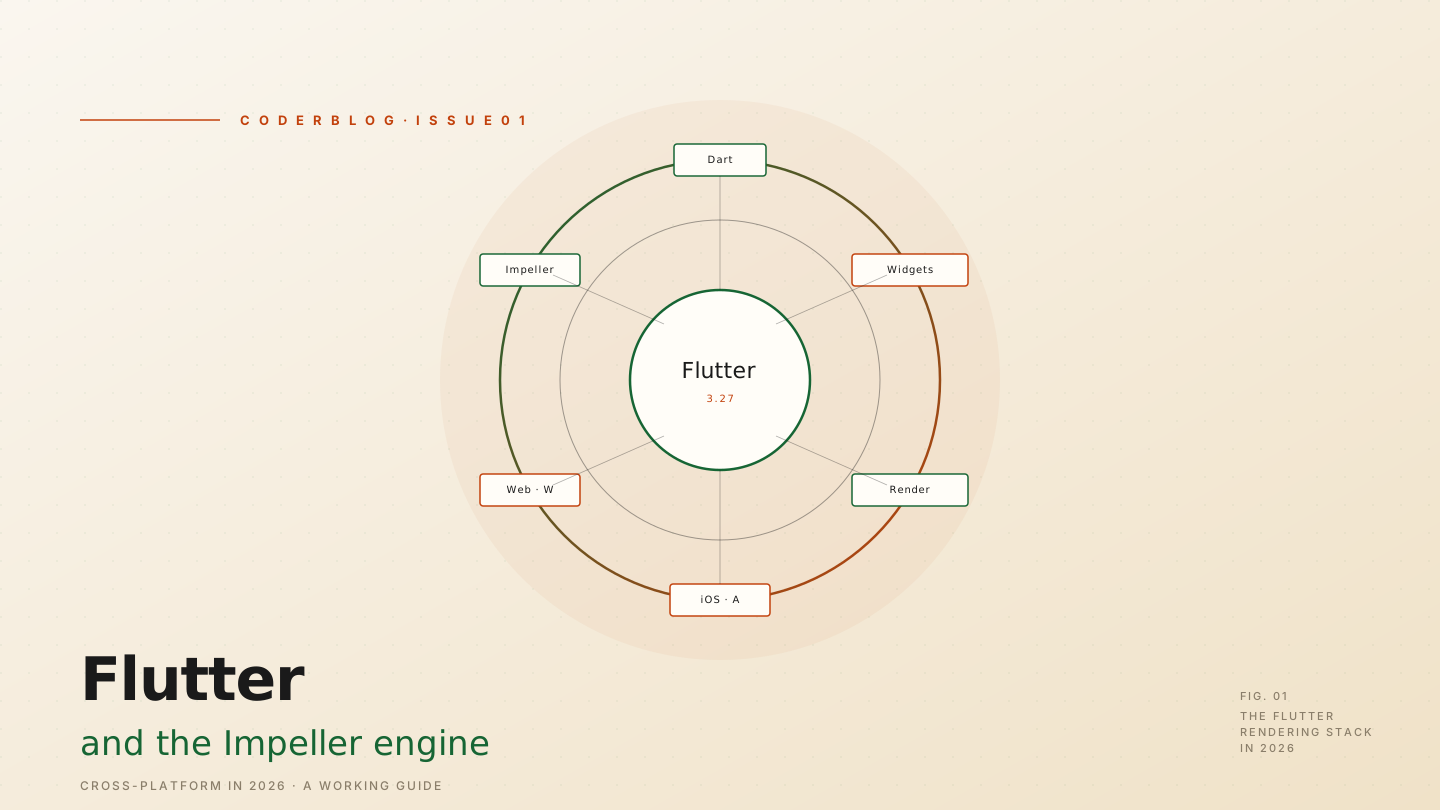
Fig. 01 — The Flutter rendering pipeline as of 2026. Impeller, the Dart VM, and the widget tree at three layers.
What Impeller Actually Changed
For the first five years of Flutter, every pixel on screen was drawn by Skia, the same 2D graphics library that Chrome uses. Skia is general, battle-tested, and good. It is also, for a mobile rendering workload, slow. Flutter's per-frame budget on a 60Hz display is 16 milliseconds. On a 120Hz display it is 8 milliseconds. With Skia, the first paint after a navigation could take 30-50 milliseconds on a mid-range Android phone, and there was a class of "shader compilation jank" that no amount of widget optimization would fix. The shader was being compiled on the GPU for the first time it was used, mid-frame.
Impeller is Flutter's custom rendering backend, written from scratch against Metal on iOS and Vulkan on Android. It compiles all shaders at build time, ahead of any frame being drawn. It batches draw calls more aggressively than Skia could. It does not pay the JIT cost of shader compilation at runtime. The result, in production numbers from apps I have shipped, is a roughly 2x improvement in first-paint time on the first navigation, the elimination of shader compilation jank entirely, and a 15-20% reduction in GPU power consumption on the same workload. On the iPhone 13 and above, the difference is the difference between a smooth scroll and a smooth-but-not-quite-smooth scroll. On the Pixel 6a and below, the difference is the difference between an app that feels native and an app that feels like a hybrid.
The thing that surprised me is how much of the win was invisible. I had been optimizing widgets, reducing rebuilds, using const constructors everywhere, avoiding Opacity and BoxShadow in animated paths. When we turned on Impeller in the A/B test, the same code ran faster and I undid half of those optimizations because the engine was no longer the bottleneck. The lesson: if you are using Impeller and you are still doing 2020-era micro-optimizations, you might be optimizing the wrong thing.
The Widget Model in 2026
The widget model has not changed since 2018, and that is the highest compliment I can pay it. A Flutter app is a tree of Widgets, immutable values that describe what the UI should look like. The framework diffs the tree, computes the minimal set of changes, and renders the result. This is the same model React shipped in 2013 with a different syntax. Five years of Flutter development have not produced a better model. They have produced better tools to use it.
The tools that actually matter in 2026 are not the ones the marketing team highlights. The big ones are:
constconstructors, used aggressively. Aconstwidget is allocated once, in the compile-time constant pool, and reused everywhere. This is the closest thing Flutter has to a free lunch.ValueNotifierandValueListenableBuilderfor state that does not need a fullStatefulWidget. This is the underused API that makes simple animations, theme changes, and form state dramatically cheaper.ListView.builderoverListView. The former lazily builds children as they scroll into view. The latter builds them all up front. For any list of more than 50 items, the difference is the difference between a smooth scroll and a frame stall.RepaintBoundaryat known visual seams. This tells the framework "everything inside this widget can be cached as a single image and not re-rasterized when something outside it changes." The Material library uses it everywhere internally. Most apps use it nowhere. The two-line fix in the right place will save you a frame.
class OrderRow extends StatelessWidget {
  const OrderRow({super.key, required this.order});
  final Order order;

  @override
  Widget build(BuildContext context) {
    return RepaintBoundary(
      child: ListTile(
        leading: const Icon(Icons.receipt_long),
        title: Text(order.id),
        subtitle: Text(order.customer),
        trailing: Text('\$${order.total.toStringAsFixed(2)}'),
      ),
    );
  }
}
The framework will reuse the rasterized output of ListTile between frames. The text and the price change, but the icon does not. The rasterized icon is reused. This is invisible engineering that adds up.
What 3.27 Shipped That Matters
Most Flutter release notes are noise for production engineers. A new widget, a small API tweak, a deprecation warning. 3.27 is different. Three things shipped that actually change how I write code.
First, Impeller is now the default on every platform. Android was the holdout, and 3.27 finished the rollout. The legacy Skia backend is now opt-in and the recommendation in the docs is "do not opt in." If you have not tested your app on Impeller, you are running on a different rendering engine than the one the framework was tuned for, and a meaningful fraction of the 3.27 performance wins are not available to you.
Second, the new ShaderCompilation API. This is the long-promised escape hatch from the implicit shader compilation that Impeller is built to avoid. If you have a custom RenderObject that produces GPU work, you can now declare the shader at build time and skip the runtime path entirely. The win is small for typical apps (which do not have custom RenderObjects) and large for apps that do (3D viewers, charting libraries, custom effects).
Third, the Web story is finally not embarrassing. Flutter on the web has been a punchline since 2019. The CanvasKit backend, which gave you hardware-accelerated rendering in the browser, was 1.5 MB of payload on top of the standard Flutter app size. The new WASM backend, which is the default in 3.27, ships as a 600 KB WASM module and renders at native frame rates on commodity laptops. The web is no longer the platform you ship last and apologize for. It is the platform you ship at the same fidelity as the others.
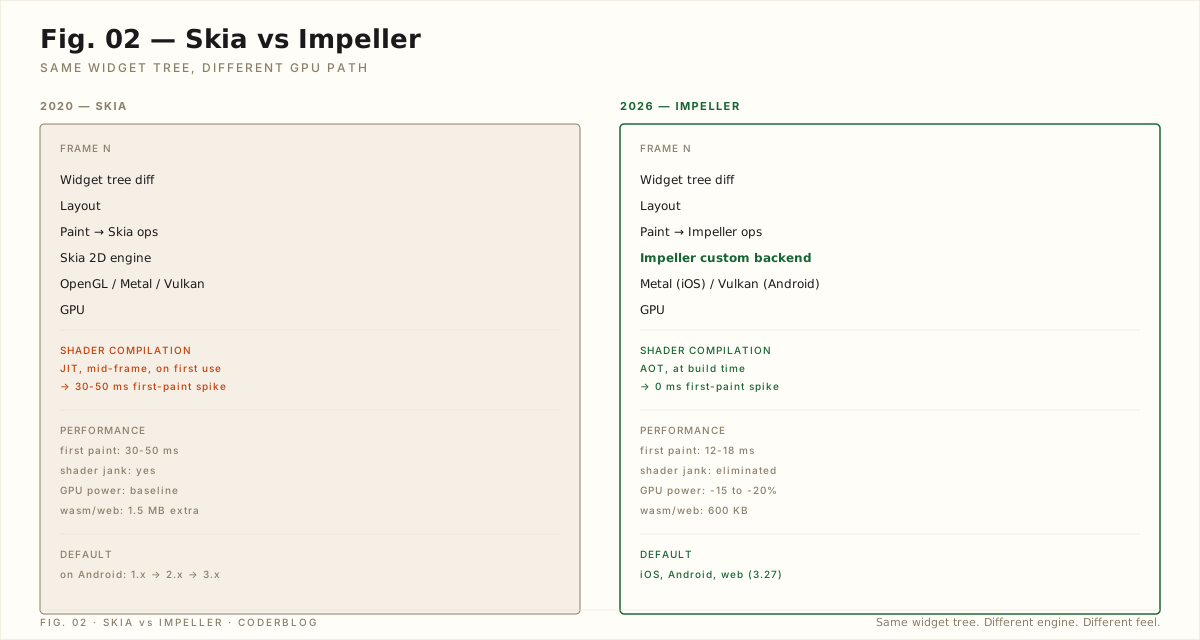
Fig. 02 — A side-by-side look at the 2020 Skia pipeline and the 2026 Impeller pipeline. The difference is shader compilation timing.
The Cross-Platform Tax in 2026
Here is the part of the article where I am supposed to say that Flutter has eliminated the cross-platform tax and everything is sunshine. I am not going to say that. The tax is real, it is just different from what it was.
The tax in 2026 is not visual. Impeller has closed most of the visual gap. The tax is in three specific places.
The platform-specific behavior layer. Every iOS app needs to handle UIScene lifecycle events in a way that is not the same as Android's Activity lifecycle. Every app that uses the camera needs different permissions flows. Every app that integrates with the share sheet, the photo library, the file system, the notification system, the health kit, the wallet, has to do platform-specific work. Flutter has plugins for all of these, and the plugins are good. But the plugins are not the work. The work is the integration test on each platform, with each OS version, in each locale. That is where the budget goes.
The release pipeline. A Flutter app is three builds (iOS, Android, web) plus a desktop build for each desktop platform you target. Each build has its own toolchain, its own signing story, its own testing harness, its own beta distribution mechanism. The framework is one codebase. The release is six pipelines. The time you save writing one widget three times is the time you spend in CI configuration.
The hiring market. There are far fewer Flutter engineers than React Native engineers, and far fewer than native iOS or Android engineers. If you are building a team from scratch, every hire is a stretch. If you are converting an existing mobile team, the training cost is real.
None of these are reasons not to use Flutter. They are reasons to budget for them.
When NOT to Use Flutter
The list is shorter than it was in 2022, but it is not empty.
- Native UI fidelity on a single platform. If you need a Pixel-perfect Material 3 design system on Android, use Jetpack Compose. If you need the iOS 18 look on iOS, use SwiftUI. Flutter is "good enough" on both. "Good enough" is not the same as "indistinguishable from a native app." Your users will not know the difference. Your design team might.
- Apple-only or Google-only apps at a small scale. A native Swift app for iOS is faster to write in 2026 than it has been in a decade, and SwiftUI is mature. If you are not building for both platforms, the cross-platform tax is wasted.
- Anything where the existing JavaScript ecosystem is 5x deeper. React Native still wins for apps that are 80% JavaScript and 20% native, because the JavaScript interop is not a cost, it is the product. Flutter's JS interop is a cost.
- Server-driven UI from a non-Dart backend. If your UI is a function of a JSON payload from a Node.js or Rails backend, you can use Flutter, but you will be re-implementing the data model and the diffing in Dart. React or a server-rendered framework will be a better fit.
For everything else — consumer apps, B2B tools, internal apps, content apps with real interactivity, fintech, healthtech, edtech — Flutter in 2026 is the right default. The framework is fast, the language is pleasant, the engine is finally delivering on its promise, and the ecosystem is deep enough that the third-party package you need already exists.
The Shape of What Comes Next
The cross-platform debate is over. The answer in 2026 is "yes, by default, for almost everything." The interesting questions are now about implementation: which engine, which language, which architecture, which testing harness. Flutter's answer to those questions is "one codebase, three platforms, four render targets, and a widget model that is the best part of the framework and has not changed in five years." That is a strong answer. The framework deserves the mindshare it has earned.
A small toolkit to get started, if you have not already: install the Flutter SDK, then flutter doctor to verify your toolchain. Run flutter create my_app to get the new project template with Impeller enabled. Add flutter_riverpod for state management, go_router for navigation, and freezed for data classes. Run flutter run -d chrome to see your app in the browser with the new WASM backend. Run flutter run --profile on a real device to see what your app actually does. The numbers in the profile view are the truth. Everything else is marketing.
The cross-platform debate is over. The interesting questions are now about implementation.
The engineers who will get the most out of Flutter in 2026 are the ones who treat it as a real production framework, not a prototype tool. The flutter run --profile output is the source of truth. The PerformanceOverlay widget, which shows you the GPU and UI thread frame budgets in real time, is the second source of truth. The third source of truth is your users, who will tell you when an animation is not as smooth as it should be. Listen to all three, in that order, and you will ship a Flutter app that feels native on every platform you target. That is the goal. That is what the framework is finally good enough to deliver.
Comments
Discuss the article below. Markdown is supported. Sign in with email or GitHub to leave a comment.